Showing posts with label WIP. Show all posts

Sunday, February 12, 2017

Work in Progress


This is what I'm working on now (while I wait to hear the fate of my Civil War novel) -- a loosely connected series of short stories set in my neighborhood or someplace similar. 

Here's the opening of The Carrion Crow:


THE CARRION CROW

Frances packs up her little overnight bag and takes three containers of her special chicken vegetable soup out of the freezer. She is making ready to go stay with Miz Petunia Shelton who is lingering on death’s doorstep past all reason. After two weeks of waiting by their mama’s bedside to be with her at the end, old Miz Shelton’s children have given up. They need to get back to their jobs and their own lives in Charlotte and Atlanta and Knoxville.  They all still work, though they are up in their sixties, and since their mama won’t die, they have called in Frances who used to be an aide in a nursing home and isn’t afraid to change a diaper or clean up a mess.

She looks around her little apartment for the Word Search book she is working on and for her bag of romance novels from the library. A job like this involves a lot of sitting and she wants to be sure to have some entertainment on hand. TV might bother the patient though Frances has been in houses where the TV runs night and day, a winking blue light and a low background noise that some folks get uneasy without. You never know just what you’ll find.

 This ain’t her first rodeo, sitting with the dying when their family couldn’t or wouldn’t do the job. There are some who call her the Angel of Death for her calm and gentle way with the dying one. There are others, and she could name names but won’t, who call her the Carrion Crow or maybe the Carrying Crow and say she does this job in hopes of carrying off bits and pieces that the dying person or their family might give her.

It’s true that folks have given her things. The dying, when they’re still in their right minds, are often eager to be shed of worldly possessions; maybe thinking on the Bible verses about the rich man and the camel and the eye of the needle,  they want to lighten themselves to ease the trip to the other side. Or maybe they just like to believe someone will remember them kindly when they look at the plate with the Praying Hands, or the little microwave that’s been in the box since the grandchildren sent it last Christmas, or the mouse-stained quilt top that’s lain at the back of the closet shelf for thirty years. Frances always accepts whatever it is in the spirit in which it’s given and finds a place in her life for these precious gifts, trying to remember to say a little prayer for the giver every day. 

Sometime she sits in her recliner (a gift from Juanita Sprinkle’s daughter after Juanita passed) and goes around the room, looking at all the mementos and naming and praying for each of the ladies she’s stayed with – and she only stays with ladies any more, after the bad time she had with old man Ray. Who would have thought a feeble old fool on his death bed could have had such nasty thoughts or been so bad to grab?

The Word Search is in the pocket of the recliner. She pulls it out, along with her red ballpoint pen, and drops it in the bag with the library books. Her only houseplant – a jade plant that the late Dessie Randall gave her -- has had its little drink and will do fine even if she’s gone a week or more.

Frances climbs into her cute little blue Ford Escort – the one that started the whole Carrying Crow business when Patsy Ramsey left it to her in her will – starts it up and pats the steering wheel. “Thank you, Miss Patsy,” she says. “I hope you’re resting easy up there.”


Monday, July 25, 2016

How You Can Help . . .


The manuscript is in my agent's hands. It will be several weeks before she gets to it -- I'm far from her only client.

I mentioned that there were some ways you all could help me as my agent begins the task of shopping my book around. 

The thing is, I'm switching from mystery to what I fondly believe is literary fiction and I have no track record there. Plus it's been five years since my last book. 

Still, it would be wise to assume that potential editors/publishers might look at my online footprint and other places to get some idea of what sort of following I might have.

I am awful at asking for stuff but I'm going to do it anyway.

Here are some things that would be helpful:

Reviews (if you liked one of my books) on Amazon or Goodreads.

A LIKE on my Facebook author's page. Friend me on my personal page.

Comment on my blog now and then. Or just click on it.  My post on the 20th soared to almost 2,000 clicks -- when the blog normally perks along at less than 500, I haven't a clue what happened on the 20th.

Buy one of my books. DAY OF SMALL THINGS, being not really part of the series, might make a nice holiday or birthday gift for a friend. A new book, it should go without saying.  The resale of used books does nothing for my "numbers." (I am a great fan of used books but we're talking here of what will make my tired old self look like a desirable property.)

If you are a library patron and they don't have my books, ask them to order some. 

These are off the top of my head. Other things may occur to me but any of these would be gratefully received.

I really appreciate those of you who offered to help! I'm in unknown territory now . . .


Sunday, July 24, 2016

THE END


Yesterday I typed those magical words to my Shelton Laurel novel -- years in the making.  I have to proofread the last three chapters I just finished and by this afternoon should be sending the manuscript off to my long suffering, patient agent as a Word doc attachment. 

Justin and Claui came up with Prosecco and flowers to help in the celebration.  I'll talk more tomorrow about what comes next. (Hint - It will be slow, glacially slow. And I could use your help.)


Friday, July 22, 2016

Weird


2

I didn't go to the Asheville library yesterday as on Wednesday I found Col. Allen's pamphlet hidden away in the Genealogy Room at the Madison County library.  


So I spent yesterday doing so very necessary watering and household chores in the morning then settled down to knock out Chapter 40 and Col. Keith. (41 through 46, as well as the Prologue and Epilogue, are done, just leaving 47 and 48.)


It's 1869. Col. Keith is in jail, awaiting trial for his role in the Massacre (as well as some other excesses.)

But the weird thing is, I've spent so much time with this fella that I'm beginning to like him a little. And he's beginning to speak like a human being instead of a self-important stuffed shirt. 

Maybe it's the threat of execution hanging over him. Maybe it's just that I'm understanding him better. Maybe with time I'll understand Trump supporters.

Weird.


Wednesday, July 20, 2016

Every Day, It's A-Getting Closer. . .


So, those crossed out numbers are the chapters I've read to myself and tidied up where necessary.  40, 47, and 48 are not yet completed, awaiting the trip to the Asheville Library. E is the (brief) Epilogue which may have a bit added after my research trip.


This little notebook is full of questions and answers -- some not exactly legible. As I neared the end of the book, I had to remind myself of children's names and ages and whether various ones called their parents Pap or Daddy or Papa and Mommy or Mama or Mam.


I still have things to find out and today I'm off to the Marshall library to find out what stores were in Marshall in 1861 and was there an undertaker. And what churches were in Shelton Laurel during the Civil War.

Tomorrow, if nothing don't happen, it's off to the Pack for a look at Col. Allen's pamphlet. Then to finish those three chapters!

If things go well, I will send this novel off to my agent next week and breathe a huge sigh of relief.


Monday, July 18, 2016

Deep In . . .

It was a fine family time on Saturday -- two sons, one daughter-in-law, a niece, a nephew, and two great nephews, wielding wizard wands. Great food and wine and talk in abundance with five dogs weaving through the crowd. (The cats chose to stay in their own room.)


Still three chapters to finish -- and they will require a trip to Asheville's Pack Library. I had thought to go today but I got started on my careful read through and realized that I had marked throughout the manuscript items that needed verification. So I decided to finish the read through before going to the library and to keep a careful list of questions to be answered.

I got through thirteen chapters yesterday -- it's slow going, reading aloud to oneself and it will likely be Thursday or Friday before I go to the library.

But the good news is, I'm really liking what I'm reading: themes are emerging; transitions are working; and the five main characters seem to have individual voices and I'm understanding them better.

Here's a brief bit in the voice of one of the five: Marthy, the so-called idiot girl who is mute but far from an idiot.


The big man comes back, grinning at me and Judy, and hands me a scratched up wooden canteen that sloshes as I take it in my hand. I duck my head thank you then I tap my finger on the canteen and look a question at him.
“You keep that canteen, honey,” he says. “There’s plenty more where that come from.”

A chill runs over me as I understand what he is telling me -- that this canteen was taken from a dead Reb – and my fingers tingle as I brush them over its flat side. I look close at it and see that amidst the scratches is some letters and, turning the canteen to the fire, I can just make out the words DIXY and E.B. Ray. I wonder who E.B. Ray was – was he old or young? Did he own slaves and was that why he had joined up? Or was he just one of them fools who loves a fight? Maybe he didn’t have no say in the matter. Once they started conscripting, less a feller had the money to buy a substitute, he had to go for a soldier whether he wanted to or not.

I flat my hand over E.B. Ray’s name and picture him – maybe a young man, not much past being a boy, shot down and all his belongings stolen. And for what? Even though he was the enemy, at least as far as us here in the Laurels would see it, I am sorry for him. And I think . . . if it was Davy . . . I take hold of the carved bone ring hanging from the string around my neck, the ring Davy made for me, and the tears begin to fill my eyes.


Thursday, July 14, 2016

Bear With Me . . .


I haven't been blog visiting or vacuuming the house or doing anything but the most minimal cooking and laundry while I chip away at those last chapters.


Three to go. 

But I really need to visit the Pack Library in Asheville for a final bit of research.  (What did the Buncombe County jail look like in 1869? And what was in that pamphlet Allen had written?) 

With a family gathering and birthday dinner Saturday night, I've decided to postpone the library visit till Monday so I won't feel rushed.

And so I have time to make a birthday cake and vacuum up up the tumbling wads of dog hair that are everywhere. . .

Looking forward to a weekend in the here and now . . . 


Tuesday, July 12, 2016

Where?!?


Five chapters to go!  I am done with Shelton Laurel and the three Shelton Laurel/East Tennessee characters. Their story lines are complete. (I had already written their closing chapters some time ago.)


But Decatur, Arkansas? Bet you didn't see that coming.  


That's where Col. Allen and his wife Polly (one of my five characters) moved in 1864. So on to my next chapter which is set in 1865 in Benton County and what will become Decatur. . .

Looks like a pretty wild and crazy place!


Wednesday, January 20, 2016

Yesterday and a Farther Yesterday


We have gone the better part of two miles when the sergeant calls out an order and our column turns up a steep trail into the woods. I am puzzled for it ain’t the road to Greeneville. We march a little farther and the sergeant calls a halt near a dry branch, a kind of shallow ravine. I am smiling for I figure Old Keith has got hisself turned about somehow. 

Everwhat the reason, we are all happy for the rest and are standing easy. I reach for the journey cake the idiot girl pressed into my hand afore we left and take a little bite. It tastes like home and I am trying to decide whether to eat the whole thing now or save a bite for later, when I see the prisoners being marched to near the little ravine. Then Sergeant Jay passes down the column, calling out one after another of us. I am the sixth to be called.

He forms us into a squad, marches us over and lines us up at attention not ten paces from where the prisoners is standing, Colonel Keith is setting on his horse a little ways off, watching all this with a stony cold face. He raises his hand and Sergeant Jay motions five of the prisoners apart and tells them to kneel there at the edge of the ravine. They are beginning to swivel their heads wide-eyed from side to side and I see the same look dawning on their faces that comes to a beast being led to the slaughter.

Our squad is put at Port Arms and then at Ready. We are holding our rifles aimed at the prisoners. I tell myself this is more of the colonel’s meanness, like pretending to hang the women. He is holding a mock execution, meaning to scare the prisoners  till they shit their britches.

One of them who is  kneeling, a white-haired old man, holds out his hands all a-tremble and hollers, “For God’s sake, men, you ain't going to shoot us.”

He looks over to the colonel who makes no sign. The poor old man clasps his hands together and calls out in a piteous voice, “If you are going to murder us, give us at least time to pray!”

“There is no time,” says Keith, in a voice I hardly recognize. If the Devil hisself was to speak, I reckon it would sound like the colonel. “Sergeant Jay, proceed.”

The sergeant is enjoying this. He stiffens, raises an arm, and calls out the Ready. We have our rifles to our shoulders and I cut my eyes to the feller beside me. His face is sickly white and his lips are tight pressed together.

Aim,” cries the sergeant and our whole line of rifles wavers then steadies. Most of the prisoners have their hands over their faces and I wonder are they praying or are they trying to hide from the bullets. I can see the colonel from out the corner of my eye and I am waiting for him to call this off and let us get back on the way to Tennessee.

But he don’t utter a word, just sets there watching.

Fire.” shouts the sergeant, his hand slicing down through the icy air.

And the whole line of us stand there frozen. It’s one thing to kill a man what is shooting at you. But it’s right awkward when that man is kneeling on the ground before you, praying or begging for mercy. A many of the prisoners had been neighbors of some of the men of the 64th and some was even members of Company A before they ran.

One of the deserters calls out, “Shelt Ray, Sol Carter, can youns shoot your old comrades in cold blood?”


At this Colonel Keith pulls his side arm and points it our way, sweeping it back and forth. “By God,” he shouts, “fire or be fired on, damn you all. Fire or join the prisoners.”


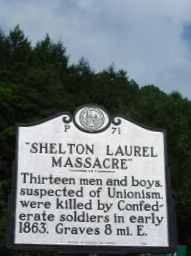
I spent most of yesterday morning with my work in progress,  writing the chapter that deals with the massacre at Shelton Laurel in 1863. It falls about two-thirds of the way through the book (there's quite a lot leading up to the massacre and quite a few repercussions following) and it is the hinge on which the entire story hangs. I've worked on this story for about five years now, reading and researching and trying to absorb the various points of view.

It's taken a while for me to feel comfortable in the heads of my various characters and to understand their motivations. I've skipped ahead, writing scenes and even chapters that occur in the aftermath of the massacre, avoiding the pivotal event because it wasn't coming to me.

 But as I wrote yesterday, following the various historical accounts but speaking through the eyes of my fictional conscripted soldier, the story began to unfold, telling  itself just as if I were watching and recording events.

And when I finished the chapter and hopped over to Facebook for a break, I was met with a posting on the page for Descendants of the Shelton Laurel Massacre, noting that it was the anniversary of that long ago event -- January 19, 1863. 

I hadn't paid attention to the date -- though it was in the chapter heading as well as right there on my computer

Is that the music from the Twilight Zone I hear?


Saturday, February 21, 2015

Work in Progress


Library of Congress
These snowy days have been perfect for making some good progress on the Civil War novel (working title THIS WAS THE WAY OF IT.) And I've at last gotten a handle on the personality of one of the most difficult (unsympathetic) characters -- to the point that he's talking to me like the others are.

The novel is fiction, of course. But it's based on real people and real incidents in my county. I've spent the past few years getting a grasp on the various versions of what happened -- and there are various versions, believe me. In the end, I simply had to go with what seems to be accepted by most folks as the probable truth and tweak it here and there to make a good story

I've just finished a chapter set in a Rebel camp  and I spent a lot of time on the internet, looking for the little details that will bring the story to life -- like these tents with chimneys topped with barrels in the picture above from an informative site HERE.


I hadn't realized how many photographs there are from the era -- these are from various collections in the Library of Congress. Itinerant photographers made this a very well documented war and these photos provide a wonderful resource that helps me to visualize the people and places I'm writing about


Some of these photos make me smile -- look at those four guys showing off! And others -- like the picture below of an apprehensive looking, very young soldier with his Bowie knife -- break my heart. 

These are the stories I'm trying to tell -- not the dry facts of battles and skirmishes, but the effects of this conflict on the people -- soldiers and civilians on both sides.

Don't ask when it will be available -- don't even ask when it'll be done. When the characters have finished with me, I reckon. At this moment they're crowding around me and jabbering in my ear, eager to tell me just what was the way of things back then.


Friday, January 23, 2015

W Not M . . . and On Inter-conectedness . . .


 Back to that Ledger. A closer look tells me it's W. Jones -- not M. I remain fascinated with this guy with his lost baseball (10 cents,) his 'segars' and plugs of tobacco, and his soda fountain visits (50, 25, 50, and 50 cents again) -- was he treating a lady -- or just extra thirsty? Remember, 50 cents equalled five hours work.


A comment from Esta suggested Maryville College - MC) in Tennessee as the school W. Jones was attending. It was in existence in 1910 and sounds like a very interesting place -- integrated from the beginning until forced to segregate by state law. I have emailed the library there to ask if they have a copy of the school's 1910 annual -- and if a W. Jones is in it. (He recorded spending a princely $2 -- that's 20 hours worth of work -- for an annual that year.)


Ah, the inter-connectedness of things -- Maryville (near Knoxville) is the setting of part of my work in progress -- the Quaker sweetheart of one of my main character lives there and tends a stop on the Underground Railroad.  And in rousting through yet another drawer as part of the tidying up frenzy that uncovered the ledger, I came across the address of a student at one of my Rugby workshops who lives in . . .you guessed it, Maryville.


Excerpt from WIP -- working title  THIS WAS THE WAY OF IT. Sim is visiting his sweetheart Cora at her family's farm in Maryville . . .


As Cora lit a tallow dip that she had taken from her basket, I begun to see some better. There was pallets of straw and old quilts along one wall and a rough low table with a bench on either side took up the middle of the room. A big man, the blackest of any man I had ever seen, was setting on the pallets with one leg stretched out so's his bandaged foot could rest on a folded blanket. Another man, some younger and not so black, was at the table along with an old woman wrapped up in a shawl. Across from them was what I took to be a white woman holding a white baby and two young uns beside her, one kindly coffee-and-milk colored -- what folks call a 'mule,' and the other real dark. I couldn't make no sense of what the white woman and her baby was doing there with a bunch of runaway slaves. 
                They had all of them perked up at the sight of Cora and the basket but when they saw me, they looked scared. The big man started to stand up but Cora stopped him.
                  “Stay down, George,” she says. “Sim is a friend. Let me share out the food and then I’ll tend to thy foot.”
                      “Bless you, Miss Cora,” the woman says, and the men and the young uns says, “Bless you. Bless you.”
                 Cora shared out the food in bowls and you never saw people so happy to eat beans and bacon and cornbread. She had a jug of new milk too which they passed around and the young uns licked their lips over its sweetness.
              Then she called me to hold the tallow dip close while she undid the big man’s bandages.
             When I saw the nature of his wound, it took all I had to keep my supper from coming back up. Ever one of his toes had been cut off.

Thursday, February 20, 2014

Sim's War


I like to have a picture in my mind of the folks I  write about. I already showed you Polly Allen and her husband -- but when I'm making up a character, I look for his or her face in magazines or, increasingly, on the internet. My WIP (work in progress) has five important characters -- four of whom are real, historical people.

 But Sim, my East Tennessee farm boy/drover/wagoner's lad/conscripted Confederate soldier, is made up to fit the story I'm weaving.  So I went looking for him and found this picture on the internet -- unidentified Confederate soldier, with a bedroll, percussion rifle, and a kepi that says 4 SLG  (4th Sumter Light Guards.)

I really like the look of him -- poor fellow, I'm putting him through some hard times...

This below is from an early chapter about Sim.  


And the Lord had respect unto Abel and his offering
 but unto Cain and to his offering he had not respect.
And Cain was very wroth and his countenance fell. . .
I am puzzling out the words in my daddy’s old Bible when a stranger sets down next to me by the fire. All the others here at the inn are busy drinking or gambling and Lathern, my particular friend, has gone off somewheres, most likely with that gap-toothed girl what was making eyes at him as she brought out the victuals.
            The stranger is a dark-complected feller, something like an Injun, and with a strong nose like an Injun, but his hair is kindly curly and he don’t talk like no Injun that I ever saw.
            “Name’s Aaron,” he says, looking me up and down, “Jacob Aaron, pack peddler working my way back to Greenville, South Carolina. Though had I a mite of sense, I’d head south to Mexico or north to Canada.”
            He takes a deep draft of his cider and stares into the fire. I close the Bible, keeping the place with my thumb.
            “They say Mexico’s right hot and full of bandits,” I tell him, “and I reckon Canada’s right cold and full of savages.  You’d be carrying that pack through snow and ice nine months of the year if my geography schoolbook had the right of it. What’s wrong with this country?”
            He screws his head around and looks at me like I ain’t got no sense. “Son,” he says, “haven’t you heard about Ft. Sumter? This is a fine country, none better, but it’s about to be torn asunder. And we are setting right at one of the ripping places. It’s going to be war, make no mistake.”

            We had heard something about Sumter and the cry of war when our wagon train stopped last night at Garrett’s – a feller there had a Tennessee newspaper and he was full of talk about South Carolina taking over the fort from the Union soldiers. I knew that a while back South Carolina, Georgia, Alabama, and Texas along with several other states had voted to leave the Union. I even knew they had elected Jeff Davis to be the head of them but I hadn’t paid it much mind, figuring that it wouldn’t change my life none.
             Part of the year I drive a wagon on the Buncombe Turnpike, carrying goods between Greeneville in Tennessee to Greenville in South Carolina. Come fall I go with the droves of hogs along the same route when the packed dirt of the road turns to a mud slough. Hard work but a few more years and I’ll have enough saved to buy me a place near Maryville where Cora’s people are. 


            “Mr. Aaron,” says I, “I ain’t got no slaves nor do I want none. I just want to be left alone to tend a little piece of ground and raise up a family.  What South Carolina does ain’t none of my business.”