June -- the roadsides and stream banks in our area are ablaze with wild orange day lilies. Hardy, rapid growers, they do well wherever there's a bit of sun and moisture.Each plant produces multiple blooms and each bloom lasts only a day -- hence the name.
But they aren't wild and they aren't lilies. Hemerocallis fulva is an import from China and Japan that naturalized long ago. The unopened buds are good in stir fries and the flowers can be dipped in tempura batter and fried to produce a lacy, mildly oniony tasting treat.
There are only 20 species of Hemerocallis world wide but breeders have come up with some 20,000 hybrids, a few of which are blooming in our yard just now.
Like a celestial locomotive, the rising sun Careens along the eastern horizon, Drawing up at the far northern terminal. Here, shedding sparks and breathing fire, It stands, surrounded by dark clouds of smoke.
Summer's here! All aboard for the return trip south-- Passing through Autumn And straight on to Winter at the other end. Have your tickets ready, please ...
Miss Yves translates:
Céleste locomotive, le soleil levant
S'agite, sur la ligne d'horizon à l'est
Tirant un trait jusqu'au lointain arrêt au nord
Là, jetant des étincelles, crachant le feu
Il se tient au milieu des scories de nuages
Voici l'été!
Embarquement pour le retour vers le sud
Traversant l'automne
Droit sur l'hiver à l'autre extrémité
Vos tickets,*s'iou plait!
(Popular form for "s'il vous plaît)
Full disclosure: the sequence below was taken yesterday morning around 6:30 -- almost solstice. If I get a good sunrise this morning, I'll put it in the header. (And now I have.)
The tomatoes above look nice and full and healthy. Too full, however.
I spent some time in the garden, removing the lower leaves and the suckers from the tomatoes. They look rather sad and spindly now but they'll be benefitted by increased air around them and perhaps they won't get the dreaded blight for a while.
As I worked, I could hear the bray of the vuvuzelas from the house where the World Cup was on.
and I felt a closeness to the rest of the world as I oonched along on my rear end down the rows of tomatoes.
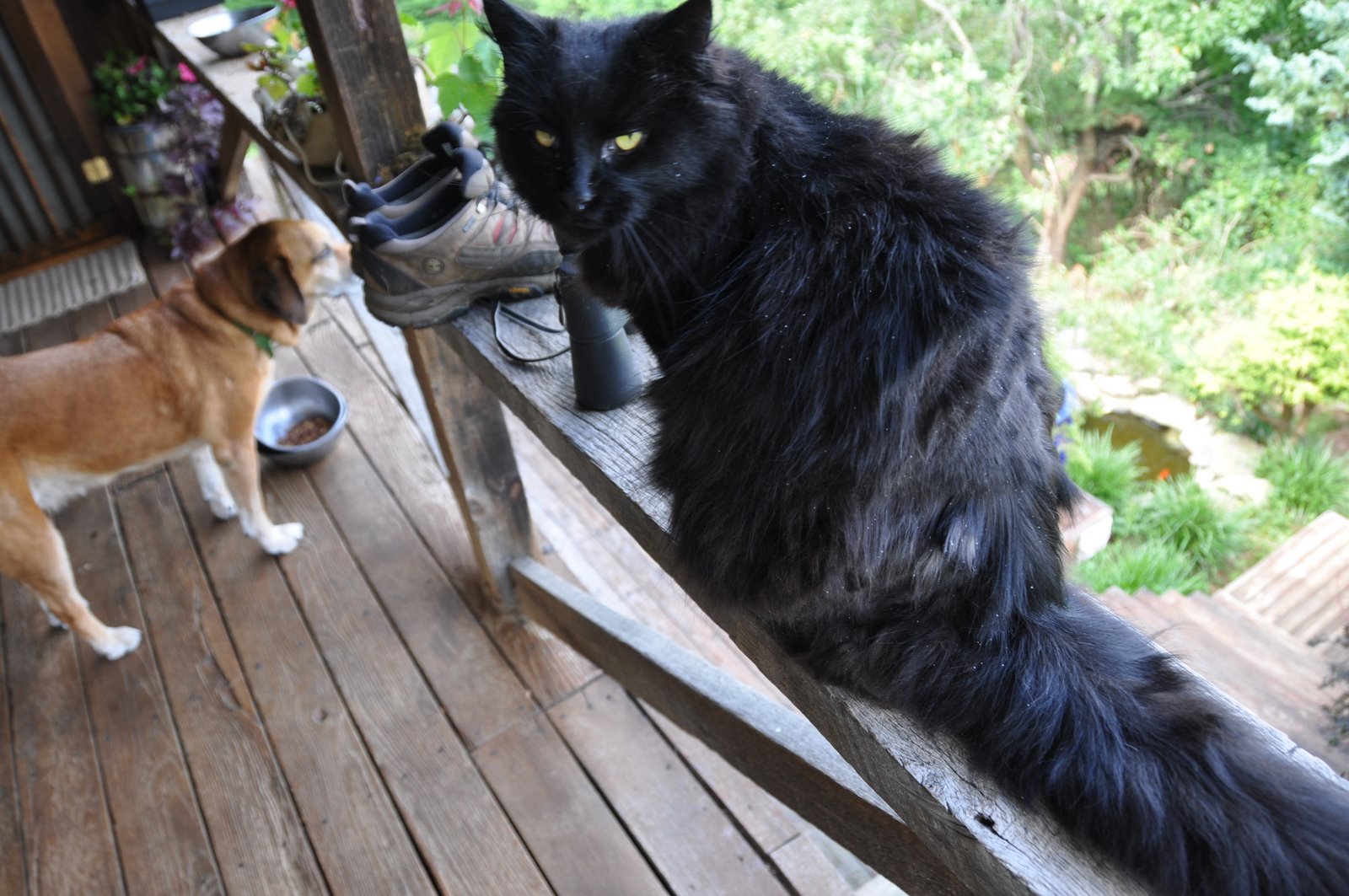
And on the subject of pruning for better air circulation, I've been trimming great fur wads off of Eddie's hindquarters. It's a slow and inexact process as I have to catch him unawares and I can get in one snip before he brings his claws into action. But over the past week, I've made a bit of progress . . .
The post office called Friday morning just before seven to say that our chicks were there. John swallowed down his coffee and went to retrieve them.
They'd hatched Wednesday and been packed and shipped right away. Baby chicks don't have to eat or drink right away and they are packed in boxes small enough to ensure that they stay warm during their travels but the sooner they can be gotten out of that shipping box, the better.
All twenty-five seemed healthy and lively. Hoorah!
This is something new for us. We've always had laying hens but, aside from one unpleasant incident involving eleven over-age cockerels, a hot August day, and far too many yellow jacket wasps, we've not butchered any of our chickens.
That's about to change. In an attempt to be better custodians of our food, we are giving this a try. These are our future chicken dinners.
The biddies are a special breed from France. Over there they qualify for the appellation Label Rouge; over here, they're marketed as Freedom Rangers.
(I sincerely hope this is not an Francophobe maneuver like that stupid Freedom Fries thing, back when France declined to follow us into the shaky ground of Iraq.)
The biddies have been decanted into a brooder box in John's workshop until they've grown a bit and added some feathers. Then they'll be shifted to their pasture home below. It will have a tarp over on end and probably some roosts and it will open into a daytime yard surrounded with electric poultry netting. The chicks will get commercial feed but they'll have the advantage of weeds and grass and bugs and worms as their home is shifted about the pasture.
And in ten weeks . . . they'll meet their end. But we hope it will have been ten very good weeks. It will certainly have been better than the life commercial broiler chickens lead..
Would you look at these great shopping bags! They were at Tractor Supply (my one stop shopping place for pet food, chicken feed, sunflower seed, and all kinds of nifty farm related stuff.)
These caught my eye because they are really sturdy and were cheap (under two dollars.)
For years, ever since becoming aware of the pollution caused by plastic bags, I've had a motley assortment of canvas bags to put my groceries in -- some bought for the purpose, others souvenirs of various book fairs and mystery conventions. (I need a bunch because I generally only shop once a week. The rest of the time the bags stay in the back of my car.)
The canvas bags have worked well -- but they have one major failing. Unlike paper bags or the plastic bags on the little racks, my canvas bags need to be held open while they're being filled. Sometimes I feel that the bag boys groan when they see me and my virtuous canvas bags.
Now that I have these snazzy carriers, I won't have to apologize to the bag boys. I will, however, have to make sure they don't fill the bags so full and so heavy I can't carry them from the car into my house. I'm pretty sure the bag I schlepped today weighed about thirty five pounds. Or more.
Another rainbow yesterday -- and this time it was double.
Such a spectacular natural phenomenon demands a good story -- whether the Irish tale of a pot of gold at the rainbow's end. . .
Or the biblical story of a sign from God that the Earth will not again perish from flood . . .
Many cultures saw the rainbow as a bridge between this world and another . . .
Or a goddess's necklace, a heavenly snake, the bow of a celestial hunter . . .
Does the scientific explanation of the rainbow as an optical phenomenon caused by the light of the sun on moisture in the Earth's atmosphere destroy its beauty?
John Keats thought so and said as much in his poem Lamia.
With all the carrying on here at the house, it was lucky that I stepped into the greenhouse yesterday morning and noticed the single swelling bud on the night blooming cereus.
These blooms open at dark and close forever with the coming of dawn. It's a one shot deal and easy to miss -- but as we finished supper, I remembered to take a flashlight and check to see if this was the night.
The intense fragrance greeted me as soon as I opened the door and there she was, in all her glory -- the Queen of the Night.
It was a fitting close to a lovely day -- a delicious lunch in Asheville with members of the extended family -- and a day that saw the coffee maker repaired, the shower drain unclogged, and the oven (we think) in working order once again. All thanks to John.
So, there were seven of us for dinner last night, plus a three year old and a lap baby. And our four dogs plus three more.
(Miss Susie Hutchins decided to observe from afar.)
It was very, very hot.
And then the oven quit working.
No worries -- move the sweet potato oven fries to the grill-- the chicken's in the new smoker. Forget the cobbler or tarte you were going to make -- ice cream and blueberries will be just fine.
The shower drain is clogged and one of the visiting dogs has just rolled in cow poop.
No worries -- point the guest to the other shower and get out the Liquid Plumber. Give the dog owner some soap and a towel and point him to the outside hose.
The smoker seems to be taking longer than it should to get those three chickens done.
No worries -- open another bottle of wine and pass the tortilla chips.
The chickens are done at last -- several hours later than the original estimate but it is so delicious that we forgive the slow smoker and open another bottle of wine to go with the meal.
Time for coffee and the abbreviated dessert. An unexplained light on the coffee maker is blinking red and the coffee is not happening.
No worries! It's time to go to bed anyway.
(In spite of one thing after another going wrong, it was a delicious meal and, I believe, a good time was had by all.)
I knew her as Aunt Barbara Dupree -- an elegant octogenarian and sister to my husband's grandfather.
Before she was Aunt Barbara though, before she was Mrs. William Dupree, she was a sausage-curled Southern belle known to her friends as Bab Knight.
Is that an armful of hydrangeas she's holding?
Bab married William Dupree, a prominent Tampa attorney who, while recuperating from a serious automobile accident that kept him from his practice, began to develop a 25 acre tract outside Tampa into Dupree Gardens -- a horticultural wonderland, meant to draw the tourist trade.
There were extensive plantings, a lodge, and electric boats, gliding over a decorative lake. Long years later, one of Bab's contemporaries giggled like a girl as she told me how she and Bab liked to gather waterlilies and put them under the bedcovers in the lodge for unsuspecting persons to discover when they turned in for a good night's sleep.
Dupree Gardens opened in 1941 -- just on the eve of America's entrance into WWII -- and after a brief success, closed in 1943, a victim of gas rationing.
Possibly because of the auto accident, the Duprees had a chauffeur.Herbert Carrington, known in my husband's family as 'Cousin Herbert,' is something of a legend. It is whispered that, as well as driving, he had on more than one occasion helped Aunt Barbara to climb out the window when William (who in later years she always referred to as 'the old gentleman) had drunk too much.
In 1942 Herbert became a waiter at the Tampa Yacht Club, rising to the post of Maitre d' -- a position he held till retiring at the age of 105.
He died at 107 after a battle with prostate cancer. At the time of his death, he was dating a younger woman -- she was 85.
Cousin Herbert and Aunt Barbara -- I'm proud to be connected with both of these folks.




 v
v


