An excellent, eye-opener of a book. From the truth about Columbus and the first Thanksgiving: popular myths propagated by elementary school pageants--remember those constuction paper Pilgrim hats and Indian headdresses? -- to US interference in sovereign nations to the invisibility of racism and any discussion of social class in American textbooks, Loewen covers the ground left untouched by standard texts.
Why have we been lied to so consistently? Because, as one publisher put it, there's always the risk of being labeled a Marxist, if you talk about social class or racism. So, despite evidence to the contrary, children in the US are taught that everyone can succeed if they try hard enough, that Native American welcomed settlers, that slavery wasn't all that bad and certainly wasn't the cause of the Civil War (states' rights!)
I read this in my 'reading room' (waiting to pick up Josie) over a period of several days. And remembered how in my time at school we were invited to feel sorry for the poor kids in Russia who were taught nothing but propaganda.
Hmm. As it turns out, so were we.
And I'm afraid it's getting worse. Textbook publishers tend to want to please the largest number of people so they will leave out controversial bits that wouldn't make it past review boards in, say, Texas or Florida.
The dumbing of America-- turning out unthinking, uncritical flag wavers who will enthusiastically vote against their own interests.
Really--READ THIS BOOK. You'll be enlightened and appalled.
. . .are condemned to repeat it. While those who do, shake their heads as it happens again and again, an endless Groundhog Day nightmare.
Actually, I'm not a real student of history. But I enjoy reading about the past and every once in a while am struck by mankind's seeming inability to learn from it.
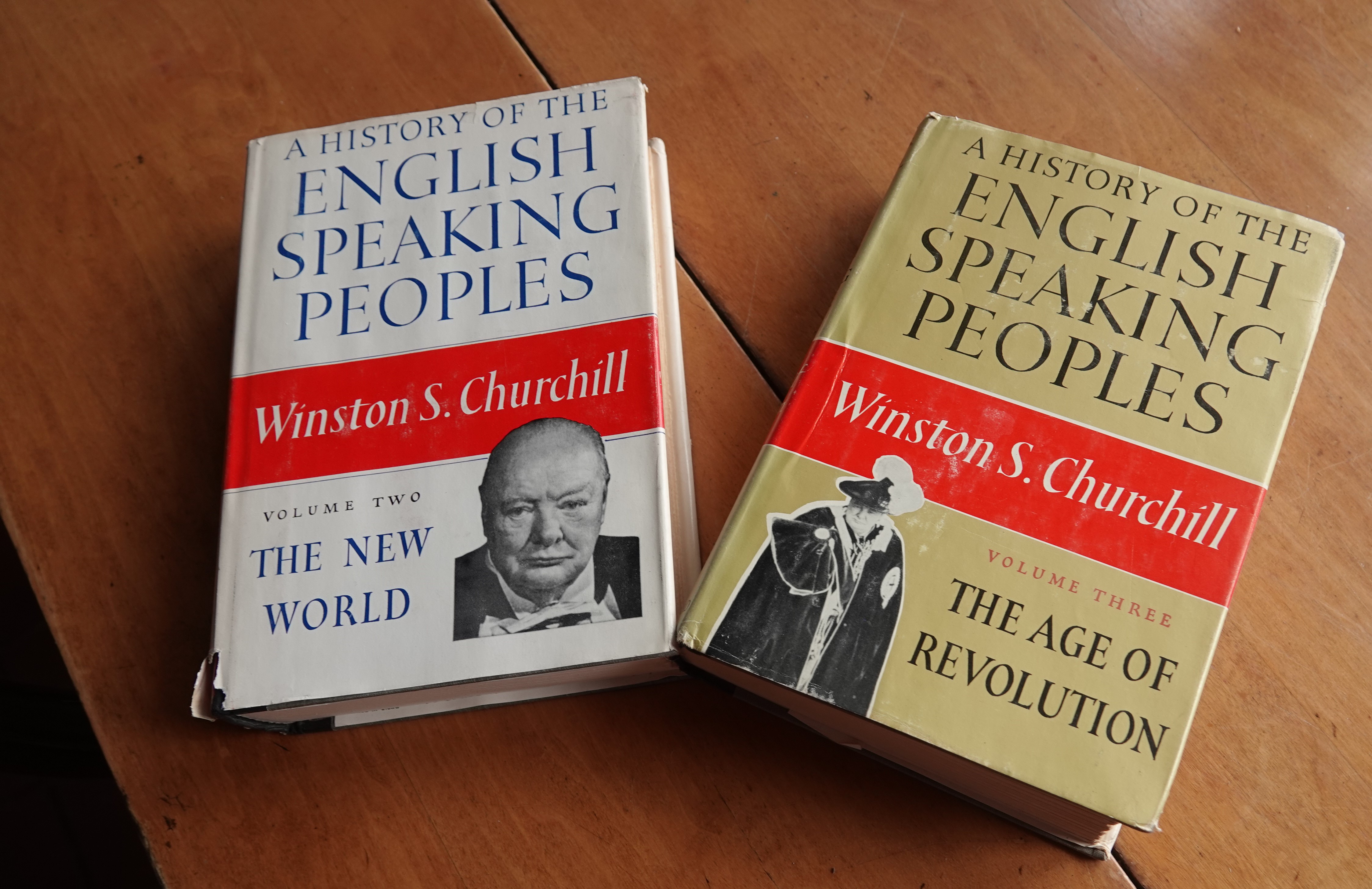
I just finished The Birth of Britain, volume one of Churchill's A History of the English-Speaking Peoples. From the Roman invasion and occupation to the Angles and Saxons and Vikings, on to the Normans and the Plantagenets, the Magna Carta and the Black Death, Joan of Arc and the Wars of the Roses, the history of the Island, as Churchill calls it, seems to be one of almost perpetual war.
And it was hard to avoid seeing parallels to today;
"The belief that the English were invincible and supreme in war, that nothing could stand before their arms, was ingrained. . . The assurance of being able to meet [the enemy] at any time upon the battlefield overrode inquiries about the upshot of the war. Few recognized the difference between winning battles and making lasting conquests. . . . While the war continued the Crown was expected to produce dazzling results, and at the same time was censured for the burden of taxation and annoyance to the realm. A peace approached inexorably which would in no way correspond to the sensation of overwhelming victory. . ."
Sound familiar? This was at the end of the 1300's and it's still true today.
Another parallel I found interesting was the Black Death. It killed nearly a third of the population and suddenly, good help was hard to find. Wages had to increase and this led, eventually, to the rise of a middle class.
We are seeing something like this today, as folks laid off low-paying, unfulfilling jobs by Covid, begin to demand better paying, more satisfactory work. It would be nice to think that our middle class will eventually be brought back to the strength it once had, when one wage earner could support a family and own a home.
Interesting times, the 1300's and the 2000's. I can't wait to see what happens next.
Martin Luther King Day -- and I was thinking about a suitable post. I took a look at my last year's post with the conclusion of King's stirring "I Have a Dream" speech and one bit particularly caught my attention.
"I have a dream that one day, down in Alabama, with its vicious racists, with its governor having his lips dripping with the words of "interposition" and "nullification" -- one day right there in Alabama little black boys and black girls will be able to join hands with little white boys and white girls as sisters and brothers."
Some of those vicious racists were probably my kin -- my maternal grandparents both grew up in rural Alabama and had family there. And when the Sixties came, with the push for integration, I was confounded to hear the views held by my beloved grandparents.
They weren't vicious racists, but they were racists nonetheless. We talked and argued and I was baffled by their intractability -- as baffled as they were by my opinions.
But I understand some of this a bit better now -- fifty years after the fact.
This little green textbook -- published in Richmond, Virginia in 1899 -- holds the key.
It belonged to my grandmother's brother -- and I can't resist including the picture he drew (his teacher, perhaps?)
But the thing is, as I began looking through this text book, I saw just what my grandparents learned in school -- and what we learn in school is often hard to undo. (Click on the pictures to enlarge and read the words yourself.)
The text -- a history of the United States -- is 423 pages long. Almost half is devoted to the Civil War (battle by battle) and the whole thing is very sympathetic to the South -- from a denunciation of Harriet Beecher Stowe's ill-informed view of slavery to this sweet picture below of the mistress of a plantation reading to the slaves on Sunday.
"The outcry against slavery had made the Southern people study the subject, and they had reached the conclusion that the evils connected with it were less than those of any other system of labor. Hundreds of thousands of African savages had been christianized under its influence. The kindest relations existed between the slaves and their owners. A cruel or neglectful master or mistress was rarely found. The sense of responsibility pressed heavily on the slave-owners, and they generally did the best they could for the physical and religious welfare of the slaves. The bondage in which the negroes were held was not thought a wrong to them because they were better off than any other menial class in the world."
Oh, dear. I read this and am outraged. Over a hundred years ago, young Claude Wright (and probably my grand mother and grandfather as well) read it and believed it.
Never mind that his family had not been slave owners (only a small proportion of Southerners were.)
The glorification of the Noble South is the sub text that runs through these pages.
"Women of every degree shared the enthusiasm, and courageously, though sadly, sent their loved ones to the army."
The ruined plantation house . . . Reconstruction . . . Oppression and Tyranny . . . the Ku Klux Klan . . . it's all here in this textbook.
A text book for racists.
It reminds me of the song from "South Pacific"
You've got to be taught To hate and fear, You've got to be taught From year to year, It's got to be drummed In your dear little ear You've got to be carefully taught.
You've got to be taught to be afraid Of people whose eyes are oddly made, And people whose skin is a diff'rent shade, You've got to be carefully taught.
You've got to be taught before it's too late, Before you are six or seven or eight, To hate all the people your relatives hate, You've got to be carefully taught!