Words and pictures from the author of And the Crows Took Their Eyes as well as the Elizabeth Goodweather Appalachian Mysteries . . .

For the past several years, Allegra and I have done book swaps. Great bulging shopping bags filled with books we think the other would enjoy change hands and we have lunch and talk--some about the books but more about the current state of politics and the world.
The recent haul included Absolution, which I picked up somewhat at random and was at once captivated by the setting: Vietnam, 1963, and then by the protagonist--newly wed Tricia whose attorney husband is 'on loan' to navy intelligence. This is before actual war breaks out. There are military advisors but the families of officers and civilians like Tricia's husband, live in secure compounds, enjoying a luxurious life.
I too was a newlywed in 1963 and the mindset that Tricia has, as well as the social expectations are all so familiar.
Tricia is swept up in the wake of Charlene, who is trying her best to 'do good.' And underlying all of this is the question of American meddling in another country.
Charlene and Tricia are compelling characters and the descriptions of Saigon and the countryside are beautifully done.
I found it to be compulsive reading--highly recommended!
My next choice from the bulging bag was Good Night, Irene, a novel based on the experiences of the Donut Dollies, a Red Cross corps formed to bring a touch of comfort to American GI, sometimes frighteningly near the frontlines.
Set in 1943 (another significant year for me as it's when I was born,) the novel follows Irene and Dot and a changing cast of Third Girls as they (wo)man the unwieldy Clubmobile throughout wartime France, dispensing hot coffee and donuts (fried fresh in the Clubmobile!) as well as their smiles and cheerful flirtation that are the real comforts.
Holding those smiles is hard as they encounter increasingly dangerous and heart-breaking situations. But their strong support for one another sees them through the worst of times. It's a fine testimonial to friendship, without ever getting soppy
It's a terrific war story--told from a female perspective and with a long overdue look at the heroism of women.
The writing is beautiful, poetic and moving--when I finished to book, it was hard to return to the here and now, so caught up in the story I'd been.
Another winner and another highly recommended.
Oh, my! I recently discovered three unread paperbacks that have been languishing out of sight in my workroom. I remember buying them back in 2009 when I was one of a number of authors at Murder on the Menu in Wetumpka, Alabama.
Deborah Crombie, Cara Black, and William Kent Krueger were among the authors, and I bought books by each of them. I devoured Deb and Cara's novels and began to follow their mystery series--one set in the UK, the other in Paris. I'd been strongly impressed by Kent Krueger's talk about his novels, set in rural Minnesota, as well as by his delightful personality, and had every intention of diving into his series. But, somehow, it didn't happen, and the books got misplaced.
My loss then--but what a bonus for me now! Back then, there were only three books in the Cork O'Connor series. And now there are eighteen!
Total immersion in a beautiful, backwoods setting, compelling situations, twisting plots, and a continuing storyline with characters I already love. Heaven!
I spent much of Tuesday's rainy day deep in the Boundary Waters, the Quetico-Superior Wilderness, "more than two million acres of forest, white-water rapids, and uncharted islands on the Canadian-American border," with a missing country-western singer and the various men who are trying to find her--some to rescue her--others to kill her.
This series reminds me of one of my favorites--Hillerman's Leaphorn and Chee novels. Cork O'Connor is part Anishinaabe, and the Native culture is strong in these stories.
I zipped through Iron Lake and am halfway through Boundary Waters now and glad that Purgatory Ridge is within reach. As for the rest of the series--with Kindle, I can scratch the itch whenever.
What a treat!
And then the gardening books. Beautiful, aspirational books but at this point in my life, I'm not making gardens. So goodby to books like The Englishwoman's Garden, The Italian Rennaissance Garden (now that was a real flight of fancy,) and all the copies of Fine Gardening. I'm keeping some, and especially the more practical, but passing on quite a few--surely there are some garden dreamers who'll give them a home.
On Wednesday, with Josie's help to reach the lowest shelves, I addressed my sci-fi collection. In my teens, I was an avid reader of this genre and I have the paperbacks to prove it. Some I'll keep--The Martian Chronicles and Dune, but others--like all the spawn of Dune, all of which I found disappointing, are out of here. As are many paperbacks of vintage sci-fi. I hope they'll find a nostalgic reader or two.
And then there's all the Heinlein. His YA books were early favorites--I just re-read and enjoyed Citizen of the Galaxy and Double Star. I won't get rid of Starship Troopers or Stranger in a Strange Land. Much of his later stuff will probably go in the box. And I found I had a copy of For Us, the Living, his first attempt at a novel, written in 1938-39, and published posthumously.
I don't remember reading it, so I gave it a shot. Yikes! As a novel, it's mind- numbingly bad-- a man is inexplicably thrown from 1939 to 2086 and people there are eager to help him understand what he's missed and the structure of the current society. It's nothing more than a device to allow Heinlein to theorize about the future--the state of the USA and the world in 2086. And to lecture on his idea of an ideal society. As Spider Robinson states in a foreword, the seeds for many of Heinlein's future novels are here.
Heinlein's vision of the future is always fun--and sometimes funny (he has folks on spaceships using slide rules.) But there was a bit in FUTL that caught my attention. In the world of this novel, in 1944, (remember, Heinlein is writing in '39) the Republican candidate for president is a Senator Malone, "a typical demagogue. . .red-faced and raucous" who ran on a "platform of blaming everything on Europe of the radicals."
"He called for the outlawing of the Communist Party, protection of the American home, and a return to rationalism in education which he defined as readin', 'ritin', and 'rithmatic and a particularly jingoistic patriotism. He advocated deportation of all aliens, laws to prevent women from holding men's jobs, and protection of the moral of the young."
Malone was elected and quickly moved to gag the press and to turn Federal agents into his own private army. Before midterm elections, he declared a state of emergency and martial law. . .
Sounds kinda familiar, though we dodged a bullet (so far.)
Heinlein got a lot wrong, but he could sure write a playbook for a would-be dictator.
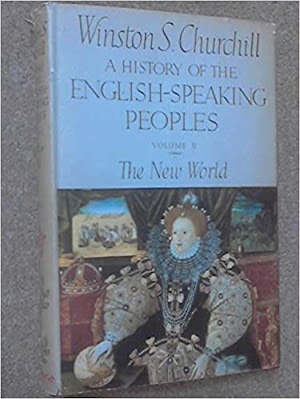
I'm still plodding through volume 3 of The History of the English-Speaking Peoples and when I reached the reign of George III, I remembered my copy of Maryanne by Daphne Du Maurier. Maryanne Clark was a high-class, high-living courtesan who became mistress to the Duke of York. She was also Du Maurier's great grandmother. It's a good story, perhaps a bit bogged down in political detail (a very corrupt government in which appointments were bought and sold, not unlike recent history.) I tended to skim through the welter of names to stay with Maryanne. Enjoyable but no Rebecca. Still, it brought to life the period I was reading in Churchill's History.