Words and pictures from the author of And the Crows Took Their Eyes as well as the Elizabeth Goodweather Appalachian Mysteries . . .
Wednesday, January 29, 2025
Judy's House
Friday, June 25, 2021
Podcast-Part 2
Wednesday, June 23, 2021
Talking About a Revolution . . .
Wednesday, June 16, 2021
Podcast!
Sunday, November 15, 2020
Fan Fiction!!!
This may be the first time I've had someone else's prose on my blog but I was so moved by Doug's piece inspired by CROWS that I asked his permission to post it here. He posted it already on Facebook and I shared it so this will be a repeat for some of you. But I wanted folks who don't do FB to see it too.
DOUG
PLEMONS Review for "And The Crows Took Their Eyes"
Posted on Facebook 10/12/2020
Davy must of heard a noise, for sudden he set bolt upright and found himself waking from a fever dream. Upon awakening it appeared that he was lying in the woods next to a small trail, mostly in a rocky ditch off to the side of the trail. He tried to wrap his thoughts around what might have brought about this strange circumstance. Why was he lying in the cold damp woods on a cold January day? He rolled his eyes to get the sleepy mist out and found that he could not. Wasn't sure why just yet. He looked around him to see a dozen of his friends and neighbors, a-lying there just as asleep as he had been.
The light---and his thoughts---seemed dim and unfocused, like as through the thickest mountain fog. Like the steam you see when you blow out your breath of a sharpish cold morning, except everything he was looking at seemed soft around the edges. Was he still asleep and dreaming? The whole world looked steamy and hot, though he knew it was bitter January.
He got up and brushed the snow off himself and his ragged tattered clothes, such as they were. His pants were torn and his shirt front was all bloody with a great red stain and he couldn't move his arms, but none of that seemed to matter. Not his state of dress, nor his lifeless pile of friends and family, nor the cold. He rose to his feet, then without making any further inquiry of his comrades, began stiffly walking down the short side trail towards someplace and something he knew. It didn't matter that he had no use of his bullet-shattered arms, or that there was a hole he could have buried his fist in on his right leg, or that part of his face was missing. Didn't matter at all. He staggered on out of the side trail, got to the junction of the horse trail that led home, and stopped dead in his tracks.
It seemed to him as he left the cover of the woods that something crucial was different in the world around him, something foundational to his world and his understanding of things. It was devil-moon quiet, for one thing. Too quiet. Usually of a morning a body would hear people on horses or a dog barking off somewhere.... nothing making a sound.
And now something new to consider.... down where this side trail ran into the main holler road, there sat a house setting at the corner where he didn't remember there ever being one. That was a stand of hardwoods he shot a boar hog at one time. But it didn't seem to matter, this difference between what was and what it seemed to be.
And the house....it looked strange and unworldly, made from materials he'd never seen before. Not at all like the old dogtrot cabin he'd grown up in and had began to plow the ground for himself with his papa gone to the war. At least this strange house had a big wraparound porch, looked like.
And there was a rocking chair.
And there was a young woman with dark hair and steady eyes, busy with her nose in a book. As he approached the house, he caught sight of a flagpole and a flag waving in the breeze. And how many stars were on that flag? Didn't matter. He had to find out why everything was so different. Maybe this woman would know. Something was drawing him to her, and she looked up, looking straight at him and showing no fear. Or, for that matter, that seeing him was unusual.
"Hello, the house," he cried out.
"Well, howdy yourself. Who be you?"
"Well I'm Davy...uh, Davy Shelton and-----"
She looked away from the book with a benevolent, knowing half smile, as if she did know something he didn't, and he had to think it, who did she think she was, the Mona Lisa herself? but thought it best to keep quiet and learn what he could. He needed to know something, and there was something unusual about her on that porch, in the same way that his own situation resonated within him. She spoke calm-like, "I think we've been appointed to meet, Davy. I believe you are the very one I am reading about in this very book."
"How so, ma'am?" He was curious. "I don't have a clue even what I'm at...er what day it is."
"Well, Davy, I think the reason for our appointment is for me to help send you to someplace you know. I think maybe you have got stuck between." She said this last with a calm air, like she was talking about hanging out the clothes.
"Between what?"
" Between your life and your passing."
"Wha----you mean I feel like this because I might be dead and cain’t quite get there. Why?" He didn't feel dead but had to admit he had nothing to compare it with. He wondered about the others all piled up back yonder and said, "If that be true then I ain't the only one."
"That's what I'm reading here. You might like this book a lot, Davy. It talks about your folks and your life here in the Laurels, and about them folks over in Marshall and why they're acting up the fool. There's a lot of why's and what-fers as to why everybody has done gone out of their mind over the state of the Union. You do know you are only standing here and us meeting like this because the nation is in a war with itself, for its soul and honor, don't you?"
He had forgotten about the war but somehow seemed to be separate from its pain and anguish here in this strange fog talking to this woman who said she was reading his life in some book.
She went on. "Honey, this book writer has got herself some common sense about the war and why your neighbors here in the county have run you out of your house and laid you dead in a ditch. There's some things I ain't gonna pass on, no need to hear it all , but do hear this. Enough to get you on your way. This war has got ever'body ground down to the bare stones, but you do need to know that Marthy is just mad with wanting to track down your killer and that her plan will succeed, but not exactly how she figgered. And you need to know that those who died with you shall all be buried together. And they will always be remembered even in times way down yet from ourn. "
'Well, if I’m dead and I'm able to talk to you, as if something bad happen to you, too?"
She looked at him for a long second then laughed and changed the subject saying, "Don’t none of that matter, Davy. I'm here to point you to where you’re headed. First thing you do is go back up there where you were and y'all will go together. So, run along and go be dead so's you can be buried with the other twelve. Go on now.... they’re waiting for you and they cain’t go till you get there."
"You sure?"
"It's the way of it."
Hmm. Seemed like that most settled everything he could think of just now so he said his goodbyes to the young lady on the porch of that house he'd never seen before. A place where he knew to be tangled woods run wild with all manner of God's critters but.... everything seemed to be resolved. That old ground was indeed calling him and so went back towards a place where time had cracked open, and his last thoughts before setting back down in the snow with the others were of the woman.
"I'm from over Kona way. My name is Frankie."
If that last sentence puzzles you, go HERE.
Tuesday, November 10, 2020
Col. Keith
From the November 8 Mountain Xpress:
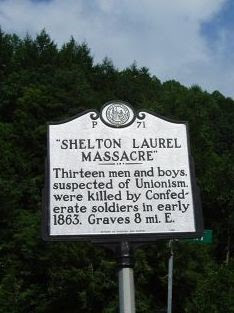
Asheville Archives: Initial reactions to the Shelton
Laurel Massacre, 1863
Posted on November 8, 2020 by Thomas
Calder
CALLING THE SHOTS: Lt. Col. James Keith, an
impressively bearded native of Mars Hill, was in charge of the North Carolina
64th Regiment, which carried out the Shelton Laurel Massacre. Photo via Mrs.
James F. Arnold, El Paso, Texas; courtesy of Southern Appalachian Archives,
Mars Hill University
On
Jan. 15, 1863, amid the Civil War, The Asheville News reported
that enemies, “not in the shape of Northern soldiers, but … of disloyal men
from Tennessee and our own State,” ransacked the nearby town of Marshall.
Confederate soldiers, the article noted, were headed to Madison County to
“restore order and security.”
Additional
information, the paper continued, “will be fully known in due time.”
Subsequent
reports explained how the region’s Union sympathizers, including those living
in Shelton Laurel, were denied salt from Confederate commissioners. With food
in short supply and salt critical for preserving meat, individuals took matters
into their own hands.
Two
months later, on March 17, 1863, The North Carolina Standard, based
in Raleigh, shared an account from an unnamed source residing in the state’s
western region. According to the individual, Confederate soldiers “shot down in
cold blood” a number of Shelton Laurel residents accused of the January raid.
The
source asserted that the officer who ordered the executions (identified in
subsequent papers as Lt. Col. James Keith) “knew that the only
object of the raid made by these [Shelton Laurel] men was to seize the salt,
which they believed was wrongfully withheld from them.”
“I
am no apologist for these miserable ignorant thieves,” the source continued.
“But I hold that the Constitution and the laws of this country guarantee to
every man and woman in the Confederacy, no matter what their crime, a fair and
impartial trial.”
The
North Carolina Standard agreed. The men accused of the
raid “committed a great wrong against society,” the paper wrote. Along with the
stolen salt, the article noted damage to private property and at least two
wounded residents.
The
men deserved lawful punishment, The North Carolina Standard continued.
But instead, the paper observed: “The musket did the work. The red hand of
vengeance was triumphant, and the voice of mercy, which is heard everywhere
except in hell, was raised in vain.”
Because
these men were denied a trial, the paper deemed the 64th Regiment’s actions
“both cowardly and wicked.”
By
the summer of 1863 several newspapers — including the Baltimore Sun and The
New York Times — picked up on the story and ran a syndicated article
describing the January killing of the 13 men and boys, which became known as
the Shelton Laurel Massacre.
The
piece features gruesome and dramatic details about the executions, including
alleged pleas made by one of the youngest victims, 12-year-old William Shelton.
“Poor little Billy was
wounded in both arms. He ran to an officer, clasped him around his legs, and
besought him to spare his life. ‘You have killed my father and my three
brothers; you have shot me in both arms — I forgive you for all this; I can get
well. Let me go home to my mother and sisters.’ What a heart of adamant the man
must have who could disregard such an appeal! The little boy was dragged back
to the place of execution; again the terrible word ‘fire!’ was given, and he
fell dead, eight balls having entered his body.”
The
syndicated report went on to note that a number of Shelton Laurel women were
also brutally “whipped and hung by the neck till they were almost dead.” Among
the assault victims was an 85-year-old resident. “And the men who did this were
called soldiers!” the article decried.
No
members of the North Carolina 64th Regiment were ever tried for the deaths of
the 13 people killed in Madison County on Jan. 19, 1863.
Today,
the Shelton Laurel Massacre continues to inspire debate, research and
publications, including the most recent work of historical fiction And
the Crows Took Their Eyes by local author Vicki Lane.
(See “Author Vicki Lane Takes Multiple Views of the Shelton
Laurel Massacre,” Oct. 23, Xpress)
Editor’s
note: Peculiarities of spelling and punctuation are preserved from the original
document.
Sunday, October 25, 2020
Polly Allen's House-Update
Monday, September 21, 2020
Disappointed! But Here's a Reading on YouTube
Well.
After posting about how well the Zooming was going, I had to bow out of the virtual reading at Malaprop's yesterday because my internet connection went all weird. And I saw some of my blog/Facebook friends were there. Drat and I'm so sorry.
So I recorded my reading on YouTube and HERE it is. Not the best but I'll try again soon.
And many thanks to those friends who showed up!
Wednesday, July 8, 2020
Beeing Here--and a Question for the Hive Mind
Monday, June 29, 2020
New Website in the Making
Saturday, November 16, 2019
Editing
This was my last chance to to tweak sentences and improve word choice. After this, if I want to make changes (other than typos or compositor errors, it will cost me.)
This is standard industry practice and makes sense. Because, alas, it's always the case that another read-through will reveal things the writer wishes she'd done differently.
This time, in spite of the fact that I've probably read through the novel twenty times, tweaking merrily as I went, I still found things to improve-- places to eliminate unnecessary words, to fix repetitions, to double check against some possible anachronisms.
I think that since I've been editing class work for several months now, my editorial eye was sharper and more attuned to really picky details. As I always tell the folks in my critique classes, editing other people's work will make you a better editor of your own stuff.
And for a bonus, I finally came up with a closing couple of sentences I like. On every previous read, I'd questioned my choice of words there. What happens at the end hasn't changed but I think the words are better.
And I'm really pleased with the novel as a whole. I love most of the characters and those that I don't, I at least have some sympathy for. They have become incredibly real to me.
I felt like celebrating when I hit SEND late Thursday night and returned the manuscript to the editor. Now a proofreader will go through it and eventually, so will I again.
Meanwhile, I've got forty more pages to edit for class next Thursday, after which I can lay down the electronic red pencil and think about things like Christmas gifts and Thanksgiving food. And all those cobwebs lurking in corners and under chairs. Now that Halloween's past, I can't claim them as decorations any more.
Thursday, August 29, 2019
And the New Title Is . . .
During the Civil War in bitterly divided western North Carolina, Confederate troops execute thirteen men and boys from a rural community opposed to secession. The Shelton Laurel Massacre, as it came to be known, is a microcosm of the deep horrors of civil war – neighbor against neighbor and violence at one’s own front door.
Based on an actual event and historical characters, And the Crows Took Their Eyes is a richly imagined portrait of a dark and bitter time—illuminated by sudden gleams of warm humanity and undying strength.